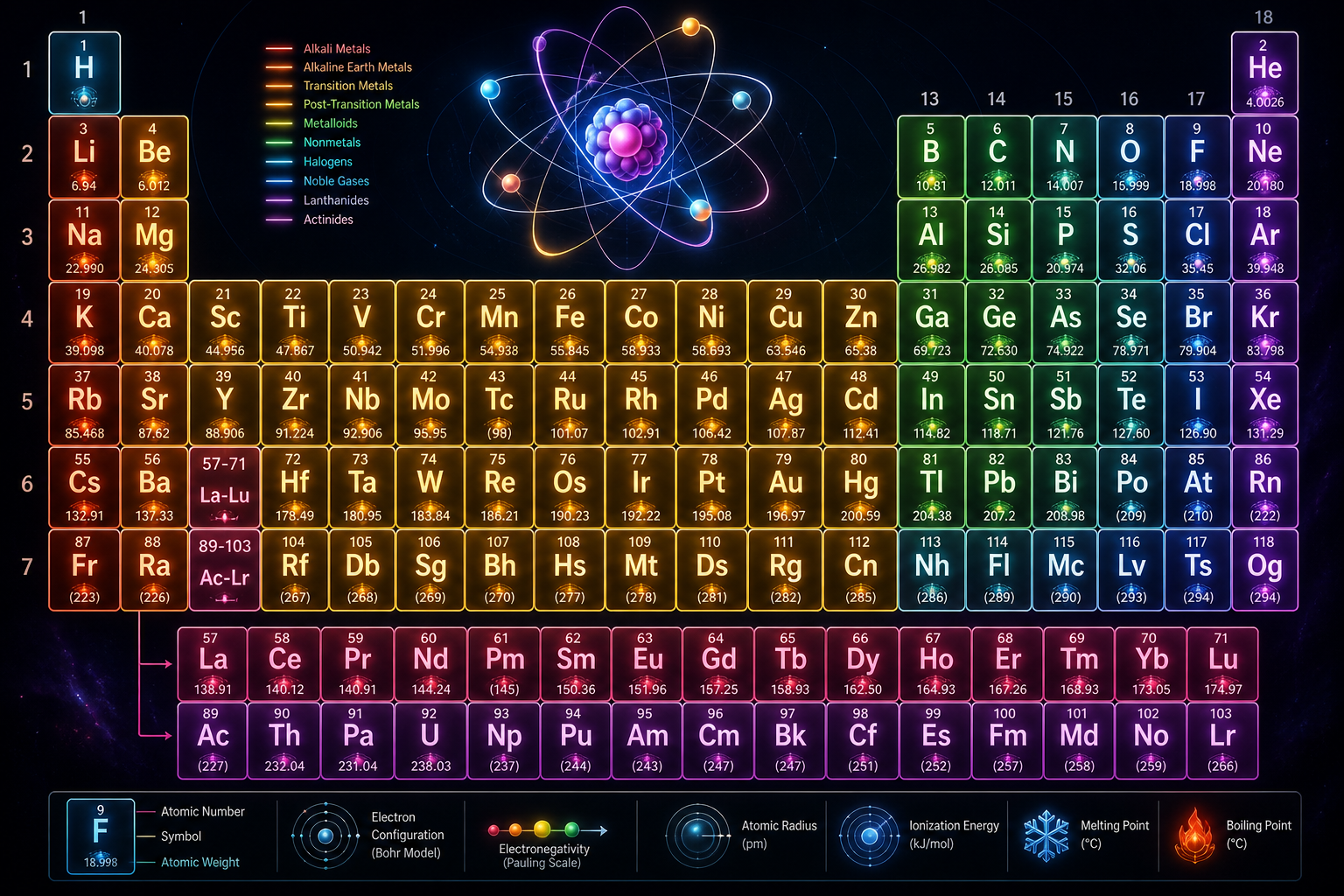
Periodic Table of Elements History Timeline and Biographies
Back to Discover Technology · English

Periodic Table of Elements

The periodic table organizes chemical elements by atomic number, revealing periodic trends in properties and enabling scientific advances in chemistry and physics.

Creation Time:2026-08-10 12 key nodes English

The Timeline

1789 — 2016

  1. 1789

    Antoine Lavoisier's List of Elements

    Antoine Lavoisier published one of the first lists of chemical elements, distinguishing metals from non-metals. This foundational work laid the groundwork for classifying substances based on their properties.
  2. 1829

    Johann Döbereiner's Triads

    Johann Döbereiner identified groups of three elements with similar properties and atomic weights, called triads. This early observation hinted at periodic relationships among elements.
  3. 1862

    Alexandre-Emile Béguyer de Chancourtois' Telluric Screw

    De Chancourtois arranged elements by increasing atomic weight on a helical graph called the telluric screw, revealing periodicity in elemental properties along the spiral.
  4. 1864

    John Newlands' Law of Octaves

    John Newlands proposed the Law of Octaves, noting that elements repeated properties every eighth element when ordered by atomic weight. Although initially criticized, this was an important step towards periodic classification.
  5. 1869

    Dmitri Mendeleev's Periodic Table

    Dmitri Mendeleev published the first widely recognized periodic table, arranging elements by increasing atomic weight and grouping them by chemical properties. He predicted undiscovered elements and left gaps for them.
  6. 1871

    Mendeleev's Predictions Confirmed

    The discovery of gallium and scandium confirmed Mendeleev's predictions of missing elements, validating the periodic table and its predictive power in chemistry.
  7. 1913

    Henry Moseley's Atomic Number Concept

    Henry Moseley established that atomic number, not atomic weight, determines element properties. This corrected the periodic table’s order and resolved inconsistencies in element placement.
  8. 1940

    Glenn T. Seaborg's Actinide Concept

    Glenn Seaborg proposed the actinide series, rearranging the periodic table to include transuranium elements. This expanded the table and improved understanding of heavy element behavior.
  9. 1955

    IUPAC Standardizes Element Names and Symbols

    The International Union of Pure and Applied Chemistry (IUPAC) standardized element names and symbols, ensuring global consistency in chemical nomenclature and periodic table usage.
  10. 1981

    Discovery of Element 109 (Meitnerium)

    Element 109, Meitnerium, was synthesized, extending the periodic table further into superheavy elements and pushing scientific research on nuclear chemistry and element stability.
  11. 1996

    Synthesis of Elements 114 and 116

    Elements flerovium (114) and livermorium (116) were synthesized, marking significant advances in the exploration of superheavy elements and their chemical properties.
  12. 2016

    IUPAC Officially Adds Elements 113, 115, 117, and 118

    IUPAC officially recognized elements nihonium (113), moscovium (115), tennessine (117), and oganesson (118), completing the seventh period and updating the periodic table to its current form.

Regeneration always requests fresh AI content and uses 1 query.

Download History Timeline