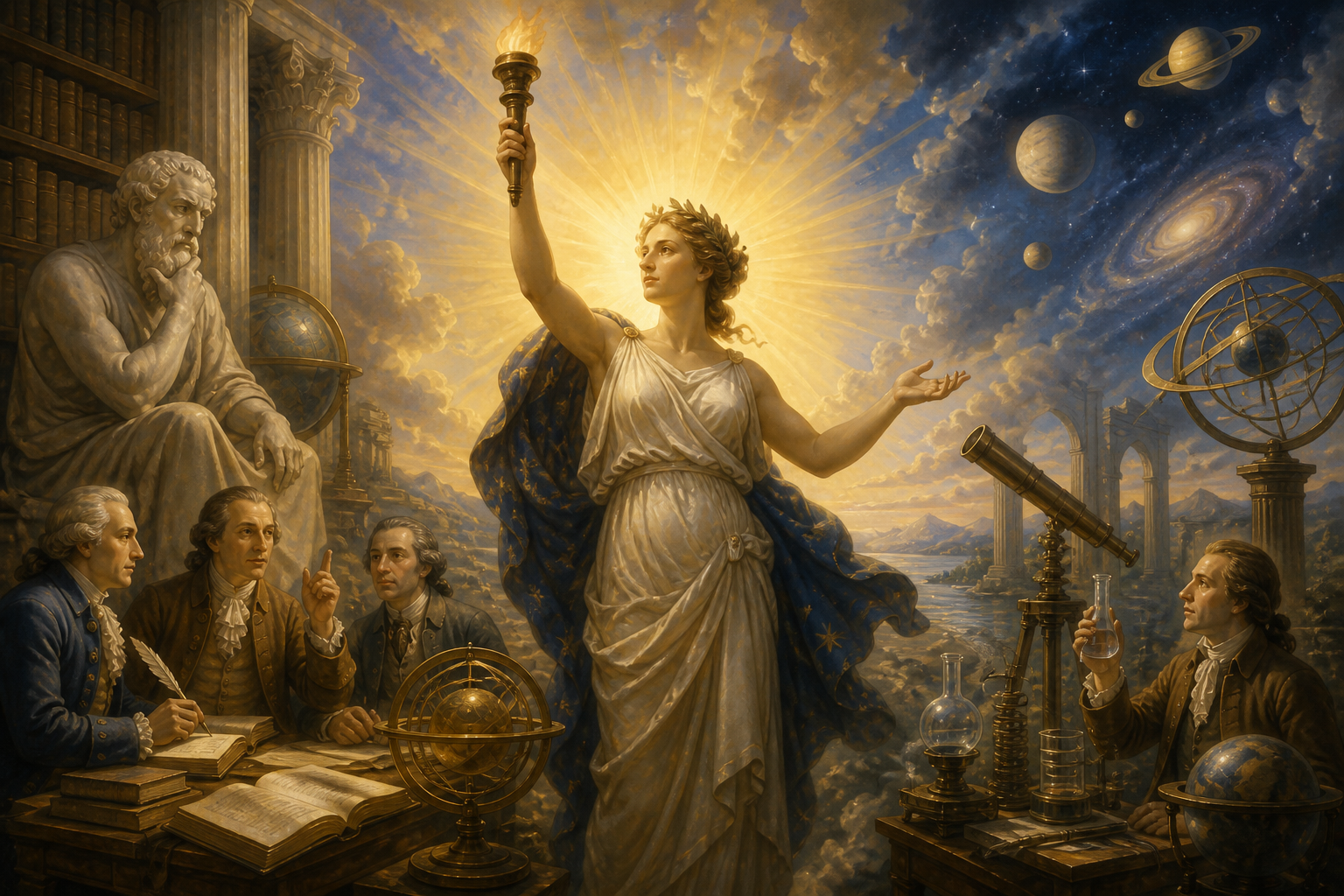
Intellectual Revolution History Timeline and Biographies
Back to Discover Event · English

Intellectual Revolution

The Intellectual Revolution marked a profound transformation in human thought and philosophy.

Creation Time:2026-09-20 10 key nodes English

The Timeline

1600 — 1800

  1. 1600

    Beginning of the Scientific Revolution

    The Scientific Revolution began in the early 17th century, challenging traditional views of the universe. Figures like Galileo Galilei and Johannes Kepler laid the groundwork for modern science through empirical observation and mathematical laws.

  2. 1637

    Publication of 'Discourse on the Method'

    René Descartes published 'Discourse on the Method' in 1637, emphasizing rationalism and the importance of doubt in the search for knowledge. This work became foundational in Western philosophy, advocating for a methodical approach to understanding reality.
  3. 1687

    Newton's 'Principia Mathematica'

    Isaac Newton published 'Philosophiæ Naturalis Principia Mathematica' in 1687, introducing the laws of motion and universal gravitation. This monumental work unified celestial and terrestrial mechanics, significantly advancing scientific thought.
  4. 1715

    Rise of the Enlightenment

    The Enlightenment emerged in the early 18th century, emphasizing reason, individualism, and skepticism of authority. Thinkers like Voltaire and Rousseau promoted ideas that would challenge societal norms and inspire revolutions across Europe.
  5. 1751

    Publication of the Encyclopédie

    Denis Diderot and Jean le Rond d'Alembert published the first volume of the 'Encyclopédie' in 1751. This ambitious work aimed to compile and disseminate knowledge, reflecting Enlightenment ideals and promoting education and critical thinking.
  6. 1776

    American Declaration of Independence

    The American Declaration of Independence was adopted in 1776, embodying Enlightenment principles of liberty and democracy. It asserted the rights of individuals and influenced revolutionary movements worldwide.
  7. 1789

    French Revolution Begins

    The French Revolution began in 1789, driven by Enlightenment ideas of equality and justice. It challenged the monarchy and feudal privileges, ultimately leading to significant social and political change in France and beyond.
  8. 1791

    Bill of Rights Ratified

    The United States Bill of Rights was ratified in 1791, guaranteeing fundamental rights and freedoms. This landmark document reflected Enlightenment values and served as a model for democratic governance.
  9. 1793

    Execution of Louis XVI

    King Louis XVI of France was executed in 1793, marking a radical turn in the French Revolution. His death symbolized the rejection of monarchy and the rise of republican ideals, fueled by Enlightenment thought.
  10. 1800

    End of the Intellectual Revolution

    By 1800, the Intellectual Revolution had fundamentally altered the landscape of thought in Europe and America. The ideas of reason, science, and individual rights had taken root, setting the stage for modern political and philosophical discourse.

Regeneration always requests fresh AI content and uses 1 query.

Download History Timeline